A monobloc or en bloc engine is an internal-combustion piston engine where some of the major components (such as cylinder head, cylinder block, or crankcase) are formed, usually by casting, as a single integral unit, rather than being assembled later. This has the advantages of improving mechanical stiffness, and improving the reliability of the sealing between them.

Monobloc techniques date back to the beginnings of the internal combustion engine. Use of the term has changed over time, usually to address the most pressing mechanical problem affecting the engines of its day. There have been three distinct uses of the technique:
- Cylinder head and cylinder
- Cylinder block
- Cylinder block and crankcase
In most cases, any use of the term describes single-unit construction, opposed to the more common contemporary practice. Where the monobloc technique has later become the norm, the specific term fell from favour. It is now usual practice to use monobloc cylinders and crankcases, but a monobloc head (for a water-cooled inline engine at least) would be regarded as peculiar and obsolescent.
Cylinder head
Cylinder block
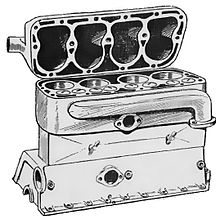


Casting technology at the dawn of the internal combustion engine could reliably cast either large castings, or castings with complex internal cores to allow for water jackets, but not both simultaneously. Most early engines, particularly those with more than four cylinders, had their cylinders cast as pairs or triplets of cylinders, then bolted to a single crankcase.
As casting techniques improved, the entire cylinder block of four, six or even eight cylinders could be cast as one. This was a simpler construction, thus less expensive to manufacture,[15] and the communal water jacket permitted closer spacing between cylinders. This also improved the mechanical stiffness of the engine, against bending and the increasingly important torsional twist, as cylinder numbers and engine lengths increased.[16] In the context of aircraft engines, the non-monobloc precursor to monobloc cylinders was a construction where the cylinders (or at least their liners) were cast as individuals, and the outer water jacket was applied later from copper or steel sheet.[17] This complex construction was expensive, but lightweight, and so it was only widely used for aircraft.
V engines remained with a separate block casting for each bank. The complex ducting required for inlet manifolds between the banks were too complicated to cast otherwise. For economy, a few engines, such as the V12 Pierce-Arrow, were designed to use identical castings for each bank, left and right.[18] Some rare engines, such as the Lancia 22½° narrow-angle V12 of 1919, did use a single block casting for both banks.[19]
Modern cylinders, except for air-cooled engines and some V engines, are now universally cast as a single cylinder block.
Crankcase

As casting improved and cylinder blocks became a monobloc, it also became possible to cast both cylinders and crankcase as one unit. The main reason for this was to improve stiffness of the engine construction, reducing vibration and permitting higher speeds.
Most engines, except some V engines, are now a monobloc of crankcase and cylinder block.
Modern engines - Combined block, head and crankcase
Light-duty consumer-grade Honda GC-family small engines use a monobloc design where the cylinder head, block, and half the crankcase share the same casting, termed 'uniblock' by Honda.[20] One reason for this, apart from cost, is to produce an overall lower engine height. Being an air-cooled OHC design, this is possible thanks to current aluminum casting techniques and lack of complex hollow spaces for liquid cooling. The valves are vertical, so as to permit assembly in this confined space. On the other hand, performing basic repairs becomes so time-consuming that the engine can be considered disposable. Commercial-duty Honda GX-family engines (and their many popular knock-offs) have a more conventional design of a single crankcase and cylinder casting, with a separate cylinder head.
Honda produces many other head-block-crankcase monoblocs under a variety of different names, such as the GXV-series. They may all be externally identified by a gasket which bisects the crankcase on an approximately 45° angle.
| This article uses material from the Wikipedia article Metasyntactic variable, which is released under the Creative Commons Attribution-ShareAlike 3.0 Unported License. |